
The New AI Cold War: How the US, China, and Europe Are Competing for Dominance
Artificial Intelligence has evolved from a technological breakthrough into a geopolitical asset. Much like the nuclear race of the 20th century or the space race during the Cold War, AI is now shaping national power, economic competitiveness, military capabilities, and global influence.
The United States, China, and Europe are pursuing distinct strategies to establish leadership in the AI era. While the United States leverages private-sector innovation and venture capital, China employs a state-driven approach focused on scale and long-term planning. Europe, meanwhile, seeks to carve out a leadership position through regulation, ethical AI, and industrial sovereignty.
The result is what many analysts describe as a new AI Cold War—a strategic competition that will define global leadership for decades.
Why AI Has Become a Strategic Asset
AI is no longer just about chatbots and image generation. It is rapidly becoming foundational infrastructure for:
Economic growth
Scientific research
National security
Cybersecurity
Military intelligence
Healthcare innovation
Manufacturing productivity
Countries that dominate AI could gain significant advantages in both economic output and geopolitical influence.
The competition increasingly revolves around five critical areas:
AI chips and computing infrastructure
Talent and research leadership
Regulation and governance
Defense and military applications
National AI strategies
1. The Battle for AI Chips
AI models require enormous computational power. The nation that controls advanced semiconductor technology controls a major portion of the AI ecosystem.
Why Chips Matter
Training frontier AI models can require tens of thousands of advanced GPUs operating continuously for weeks or months.
Modern AI depends heavily on:
Advanced GPUs
High-bandwidth memory
Semiconductor manufacturing
Data center infrastructure
Without these resources, developing cutting-edge AI becomes nearly impossible.
United States: The Infrastructure Leader
The U.S. currently maintains a significant advantage in AI hardware.
Key strengths include:
NVIDIA dominating AI accelerator markets
AMD expanding AI chip offerings
Google developing custom TPUs
Large-scale cloud infrastructure
Major AI labs have access to some of the world's largest compute clusters.
United States: The Infrastructure Leader
China faces restrictions on access to the most advanced AI chips.
In response, it has accelerated investments in:
Domestic semiconductor manufacturing
Alternative AI hardware
National computing infrastructure
Indigenous chip design
The long-term goal is reducing dependence on foreign technology.
Europe: Seeking Technological Sovereignty
Europe lacks the AI chip dominance of the U.S. but remains important through companies such as ASML, whose lithography systems are critical to global semiconductor production.
European policymakers increasingly view semiconductor independence as essential to strategic autonomy.
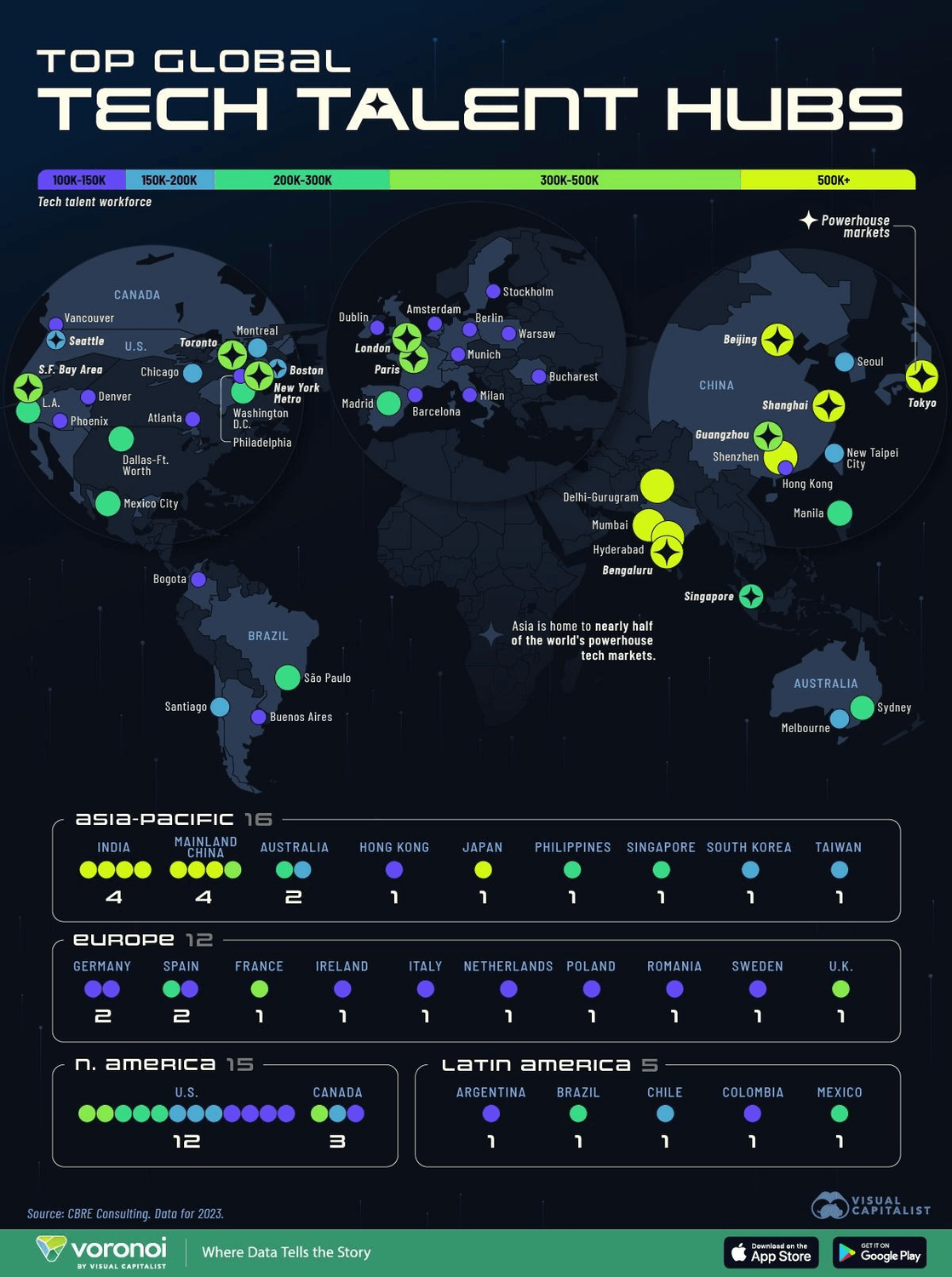
AI Talent: The Global Brain Race
(Source: Visualcapitalist.com)
Talent may be even more valuable than computing power.
The world's leading AI systems are built by highly specialized researchers, engineers, and mathematicians
United States
The U.S. remains the strongest AI talent hub because of:
Elite universities
Startup ecosystems
Access to venture capital
High compensation packages
The country attracts top researchers from around the world.
China
China produces a massive number of STEM graduates annually and is investing heavily in:
AI education
Research institutes
Government-funded innovation programs
Its strategy focuses on building a large domestic talent pipeline.
Europe
Europe contributes significant academic research and scientific expertise but faces challenges retaining top talent.
Many researchers move to higher-paying positions in the U.S. technology sector.
However, Europe continues to excel in:
Fundamental research
Robotics
Industrial automation
AI ethics
Regulation: Competing Visions for AI Governance
AI leadership is not only about innovation; it is also about setting the rules.
The American Model
The U.S. generally favors:
Rapid innovation
Market competition
Industry-led development
Regulators aim to balance safety with maintaining technological leadership.
The Chinese Model
China's regulatory approach emphasizes:
State oversight
Content control
National security priorities
AI development is encouraged, but within a framework aligned with government objectives.
The European Model
Europe has positioned itself as a global rule-maker.
Its approach prioritizes:
Transparency
Privacy protection
Consumer rights
Risk-based oversight
Supporters argue this builds trust.
Critics argue excessive regulation could slow innovation.
AI and National Defense

Perhaps the most consequential aspect of AI competition is military application.
AI is transforming:
Intelligence gathering
Cyber warfare
Autonomous systems
Battlefield logistics
Surveillance operations
United States
The U.S. military is integrating AI into:
Decision support systems
Autonomous platforms
Intelligence analysis
Advanced defense technologies
Partnerships between government and private AI companies continue to expand.
China
China has made AI a central component of military modernization.
Key priorities include:
Autonomous systems
Predictive intelligence
Smart warfare technologies
Integrated military-civil AI development
Europe
European nations are investing in AI-enabled defense capabilities while emphasizing ethical safeguards and international cooperation.
The challenge is balancing innovation with accountability.
National Strategies: Three Different Playbooks
National Strategies: Three Different Playbooks
The American approach relies on:
Private sector competition
Venture capital
Research universities
Entrepreneurial ecosystems
Strength:
Fast innovation cycles
Risk:
Fragmented national coordination
China: State-Led Acceleration
China's model emphasizes:
Long-term planning
Centralized investment
National coordination
Strategic technology independence
Strength:
Massive scale and execution
Risk:
Potential constraints on open innovation
Europe: Regulation and Sovereignty
Europe seeks leadership through:
Trusted AI
Ethical standards
Industrial competitiveness
Strategic autonomy
Strength:
Global influence on standards
Risk:
Slower commercialization
The Emerging Battlegrounds
Compute Infrastructure
Countries are investing billions in AI data centers and energy capacity.
AI Models
Ownership of frontier models may become a strategic advantage.
Data Access
High-quality datasets increasingly determine model performance.
Global Standards
The countries that shape AI regulations could influence the technology worldwide.
Who Is Winning?
The answer depends on the metric.
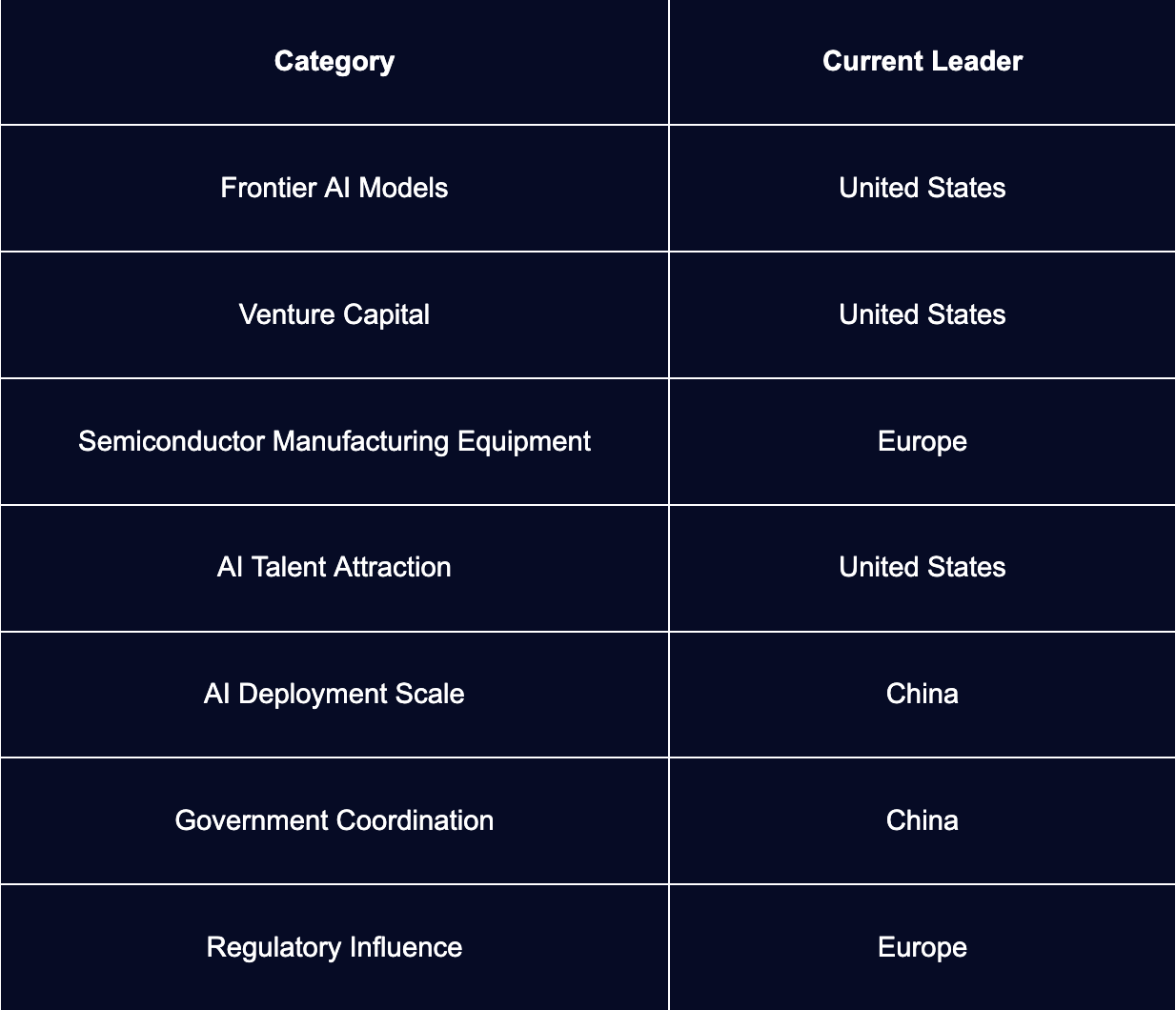
Rather than producing a single winner, the AI race may result in a multipolar landscape where each region specializes in different strengths.
Conclusion
The new AI Cold War is not merely a competition for technological prestige. It is a contest over economic power, national security, industrial leadership, and global influence.
The United States leads in innovation and frontier research. China is pursuing self-sufficiency through massive state-backed investments. Europe is attempting to shape the rules governing AI while building technological sovereignty.
The outcome will affect everything from jobs and economic growth to military power and international diplomacy. The nations that successfully combine talent, computing infrastructure, regulation, energy resources, and strategic vision will likely define the next era of global leadership.
As AI becomes the most transformative technology of the 21st century, the race for dominance has only just begun.