
The Biggest Investment Story Since the Internet
Artificial Intelligence has become the defining technology investment opportunity of the decade. Venture capital firms, sovereign wealth funds, technology giants, and institutional investors are pouring hundreds of billions of dollars into AI companies, driving valuations to levels rarely seen in startup history.
Companies like OpenAI and Anthropic have become the face of this race, attracting enormous investments despite operating in one of the most capital-intensive industries ever created. Investors aren't simply betting on chatbots—they're betting on the future infrastructure of knowledge work, software development, research, and business automation.
Why AI Companies Are Worth So Much
Traditional software companies were valued based on metrics such as recurring revenue, profitability, and customer retention. AI companies are increasingly being valued on a different set of assumptions:
Future market dominance
Proprietary model capabilities
Access to computing infrastructure
Enterprise adoption
Ecosystem lock-in
Potential to become foundational technology platforms
Investors believe that the winners of the AI race could become the equivalent of operating systems for the digital economy—earning revenue every time businesses, developers, and consumers use AI-powered services.
The Business Models Powering the AI Boom
OpenAI: The Platform Ecosystem Play
OpenAI has built one of the broadest AI ecosystems in the market through consumer subscriptions, enterprise solutions, APIs, and strategic partnerships.
Its strategy revolves around scale. By serving hundreds of millions of users and developers globally, OpenAI aims to become the default AI platform for both consumers and businesses. Revenue streams include:
ChatGPT subscriptions
Enterprise licenses
API usage fees
Developer platform services
Strategic infrastructure partnerships
This approach mirrors successful platform companies such as Microsoft, Apple, and Google, where ecosystem dominance creates long-term defensibility.
Anthropic: The Enterprise-First Strategy
Anthropic has differentiated itself through a strong focus on enterprise adoption, safety, reliability, and coding applications.
Its Claude family of models has gained significant traction among businesses seeking AI solutions for knowledge work, software development, and regulated industries. The company's revenue growth has been fueled largely by enterprise API usage and corporate deployments rather than consumer subscriptions. Reports indicate Anthropic's annualized revenue expanded rapidly during 2025 as enterprise demand accelerated.
The Emerging Challengers
While OpenAI and Anthropic dominate headlines, competitors such as Google, Meta, xAI, and Perplexity are pursuing different strategies ranging from open-source ecosystems to AI-powered search and enterprise tooling.
Investors recognize that the market may support multiple winners, much like cloud computing today supports several trillion-dollar players.
Revenue Growth: The Metric Investors Can't Ignore
Perhaps the strongest driver of investor enthusiasm is the speed of revenue growth.
Anthropic reportedly increased annual recurring revenue from approximately $1 billion to over $5 billion during 2025, driven largely by enterprise adoption and API demand. The company also reported substantial growth in large enterprise accounts and developer-focused products.
Meanwhile, OpenAI continues to expand across consumer subscriptions, enterprise offerings, and developer ecosystems, demonstrating that AI demand is extending well beyond experimentation into real business usage.
For investors, revenue growth at this scale suggests that AI is moving from hype to commercialization.
What Drives AI Valuations?
Several factors explain why investors are assigning extraordinary valuations to AI companies:
1. Massive Addressable Market
AI has the potential to impact nearly every industry, including healthcare, finance, manufacturing, education, legal services, and software development.
2. Network Effects
As more developers build on AI platforms, ecosystems become stronger and harder to replace.
3. Infrastructure Ownership
Companies that control models, data pipelines, and computing resources gain significant competitive advantages.
4. Enterprise Stickiness
Once AI becomes integrated into workflows, switching providers becomes expensive and operationally challenging.
5. Winner-Take-Most Dynamics
Many investors believe only a handful of frontier AI companies will ultimately dominate the market, creating outsized returns for early backers.
The Competitive Advantages That Matter Most
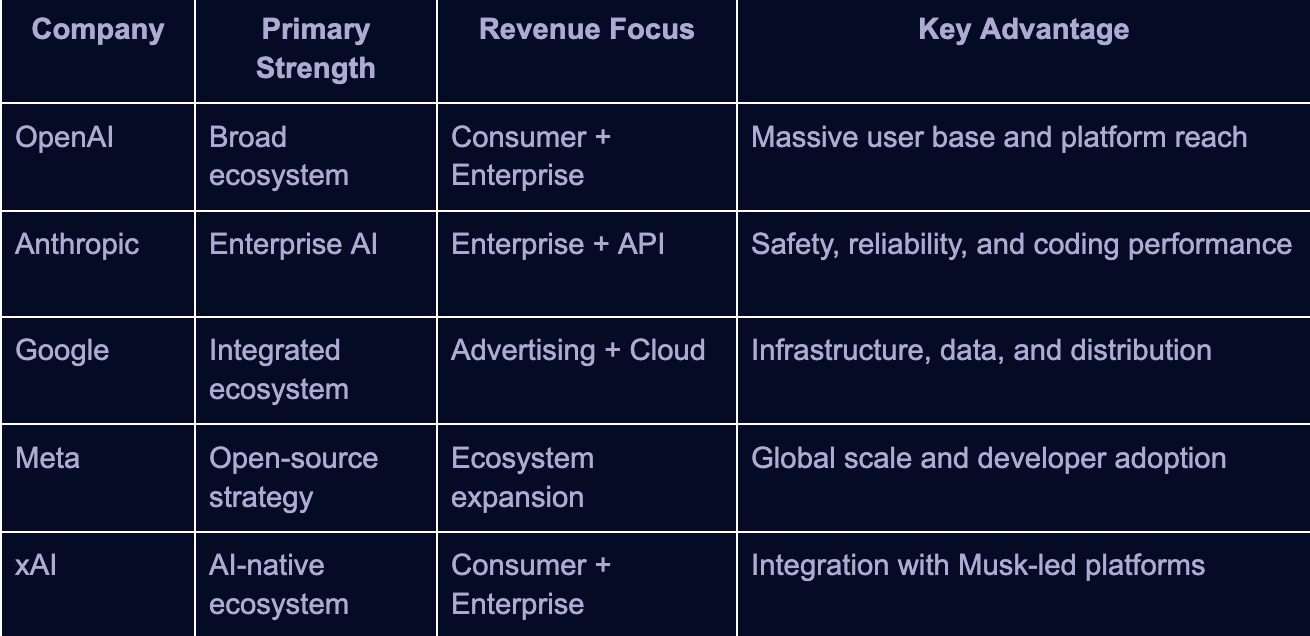
The competitive landscape remains fluid, but enterprise adoption, computing access, and model quality are emerging as the most important differentiators.
The Biggest Risk: AI's Appetite for Capital
Despite extraordinary growth, AI companies face a significant challenge: cost.
Training and operating frontier AI models requires enormous investments in chips, data centers, energy, and research talent. The industry's need for computing power has become one of the largest determinants of future success. Investors are increasingly evaluating not only model performance but also access to infrastructure and the ability to monetize usage efficiently.
Conclusion
The trillion-dollar AI race is about much more than technology. It is a battle to become the foundational layer of the future economy.
OpenAI is pursuing platform dominance through scale and ecosystem expansion. Anthropic is building a powerful enterprise-first franchise focused on reliability and business adoption. Meanwhile, major technology companies and emerging challengers are investing heavily to secure their place in the AI value chain.
For investors, the appeal is straightforward: if AI becomes as fundamental as cloud computing, search, or smartphones, today's leading AI companies could become some of the most valuable businesses ever created. The question is no longer whether AI will transform industries—it is which companies will capture the greatest share of that transformation.